Key points
- Pocket holes join stock from 1/2 to 1-3/4 in thick, and our jig guides a 3/8 in step bit through three guides at three spacings.
- The GOINGMAKE Dowel Jig Kit carries hardened bushings for 1/4, 3/8 and 1/2 in dowels and drills three holes at a time.
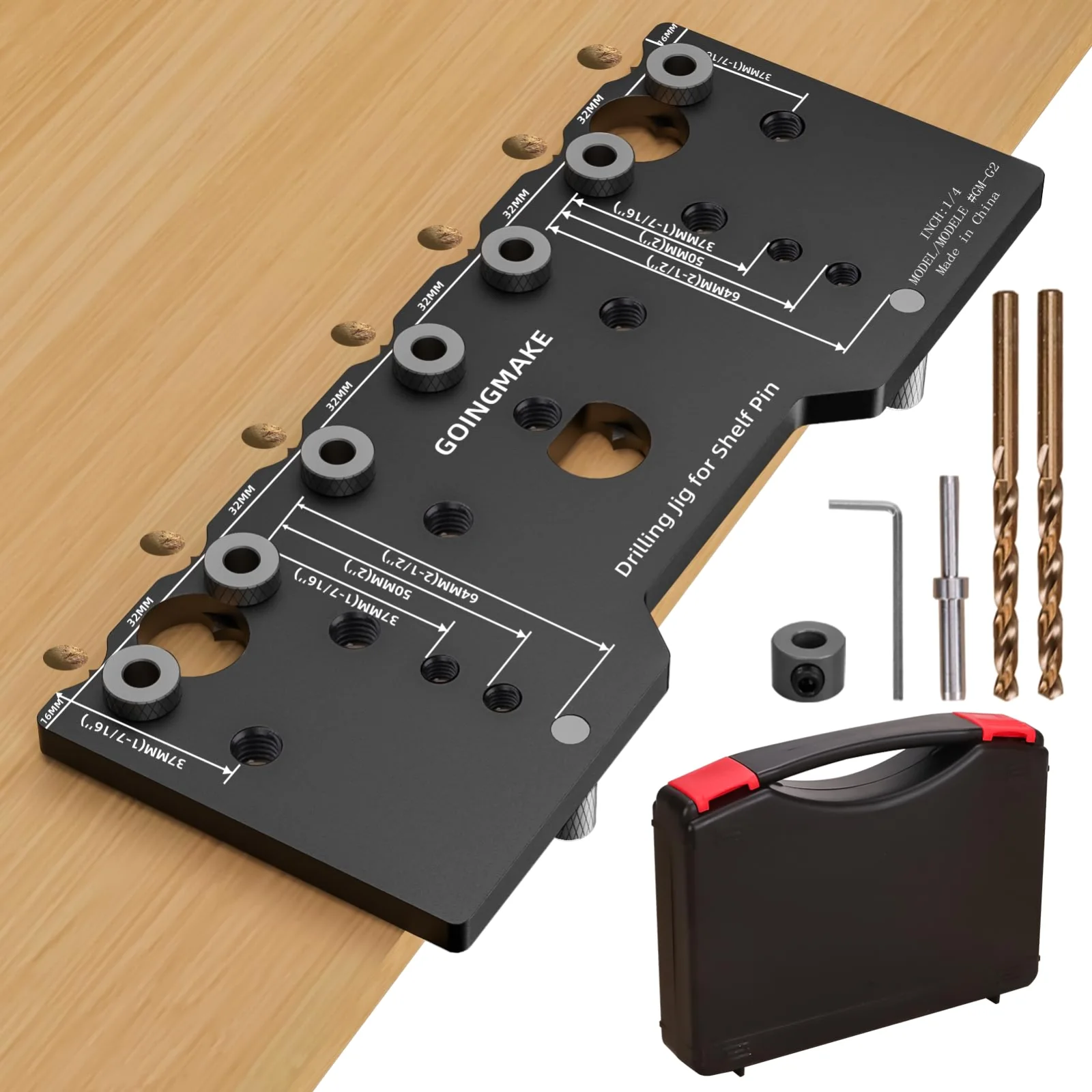
- Shelf pin holes follow the 32 mm system, set 37, 50 or 64 mm in from the cabinet edge.
- Dog holes go in at 20 mm or 3/4 in, on spacings from 64 to 256 mm.
- NIOSH sets its recommended limit for wood dust at 1 mg/m3, far below the OSHA limit of 15 mg/m3 total dust.
Pick the joint before the jig
Each of these joints answers a different question. A pocket screw pulls two parts together from one side and holds while the glue sets, which suits face frames, carcasses and quick screwed joints. A dowel joint hides inside the wood and relies on glue, which suits frames and panels where nothing should show. Shelf pins hold no joint at all: a row of small holes lets a shelf move up or down after the cabinet is built. Dog holes turn a bench top into a clamping grid.
Decide which of those you are making, then pick the jig that sets that hole. Our cabinet and joinery jigs cover the pocket screw and the dowel, and our drill guides cover the shelf pin rows, the dog holes and straight holes away from the drill press.
Pocket holes: set the jig to the stock
A pocket hole is drilled at a steep angle into the face of one part, so a screw can run out through its end grain and into the next part. The angle and depth have to match the thickness of the wood, or the screw tip breaks through the face or stops short.
Our All Metal Pocket Hole Jig Kit takes stock from 1/2 to 1-3/4 in. Measure the board, set the jig to the same figure on its inch and millimeter scales, and the drill guide follows. Three 3/8 in guides sit at three spacings, so narrow rails and wide panels each get a pattern that fits them.
The jig works two ways. On the bench base it holds big parts for a run of identical holes, and lifted off the base the guide goes where a bench jig cannot reach. A quick clamp holds the part, and a removable port takes a 1-3/8 in vacuum hose. The kit comes with two 3/8 in step bits and two drivers.

Dowels: matched holes three at a time
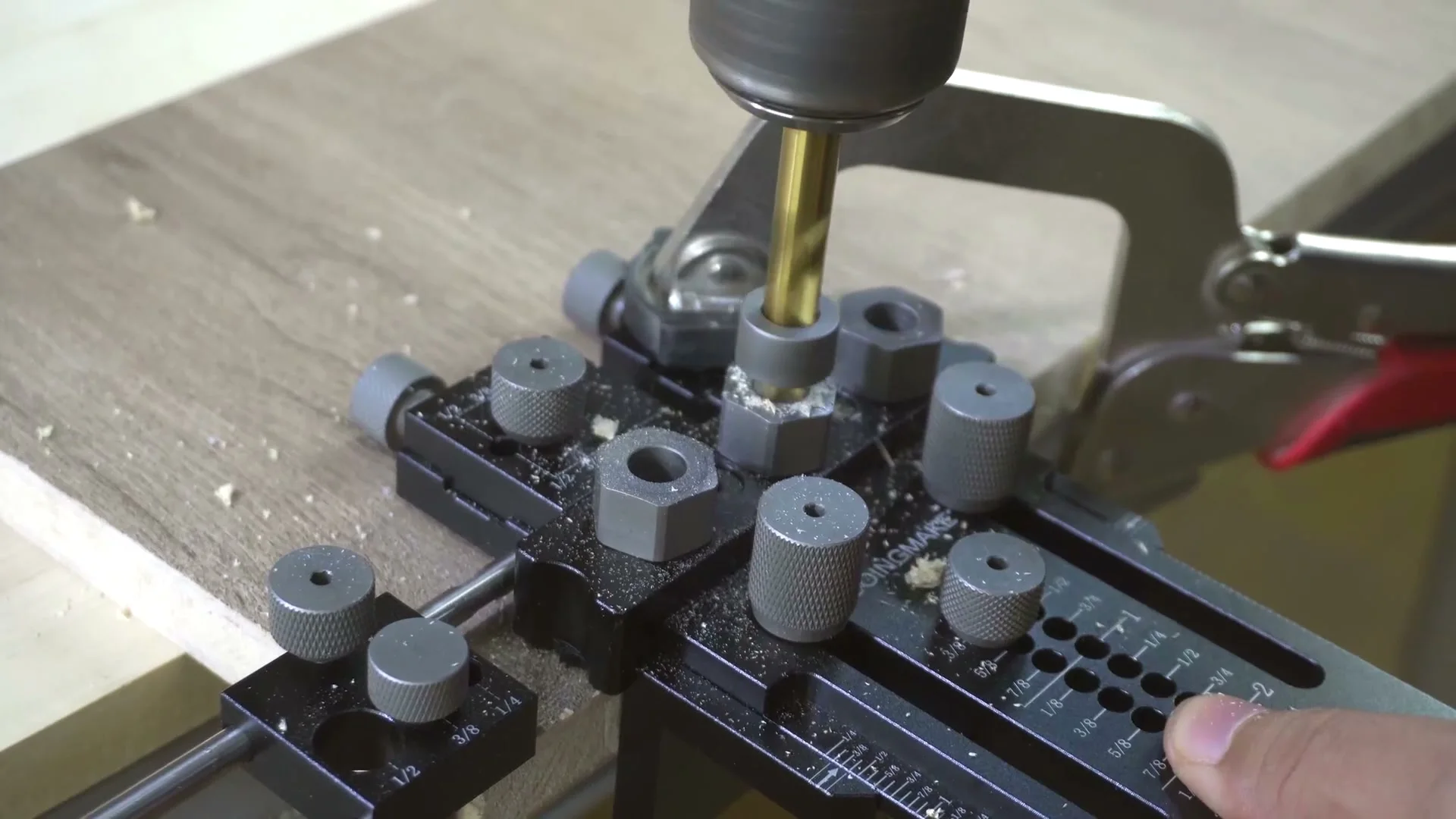
A dowel joint only closes if the holes in both parts line up to the line. Mark the joint once across both parts, then set the jig on each mark in turn. The Dowel Jig Kit carries a center-line pointer for that mark and drills three holes at a time through hardened bushings.
The kit holds bushings for 1/4, 3/8 and 1/2 in dowels, three of each, with a drill bit for each size. Positive edge stops move in 1/8 in steps and the scale reads in 1/16 in, so the holes land at the same distance from the face on every part, whatever its thickness.
For rows of joints, the edge stop system and the extension rod repeat the position along the board. Set the stop once and the jig drops onto the same spot on the next part. The quick clamp comes off when a part is easier to hold with your own clamps.
Shelf pin rows on the 32 mm system
Shelf pin holes come in long rows, and a single hole a millimeter high shows as a rocking shelf. Cabinet makers space them on the 32 mm system, and both of our shelf pin jigs follow it.
The Shelf Pin Jig, 1/4 in has seven hardened 1/4 in guides at 32 mm, set 37, 50 or 64 mm in from the cabinet edge. A locating pin carries the jig on to longer panels, and two or more jigs can be joined for a longer run. The 1/4 in and 5 mm version takes either pin size and sits on an anti-slip base, so it drills without clamps. It screws to a second jig for tall sides, sold one to a box.
Drill both sides of a cabinet from the same reference edge, the bottom or the top, and the matching holes stay level across the box. Mark that edge before you start, because a side flipped end for end puts every row out of step.
A dog-hole grid in a bench top
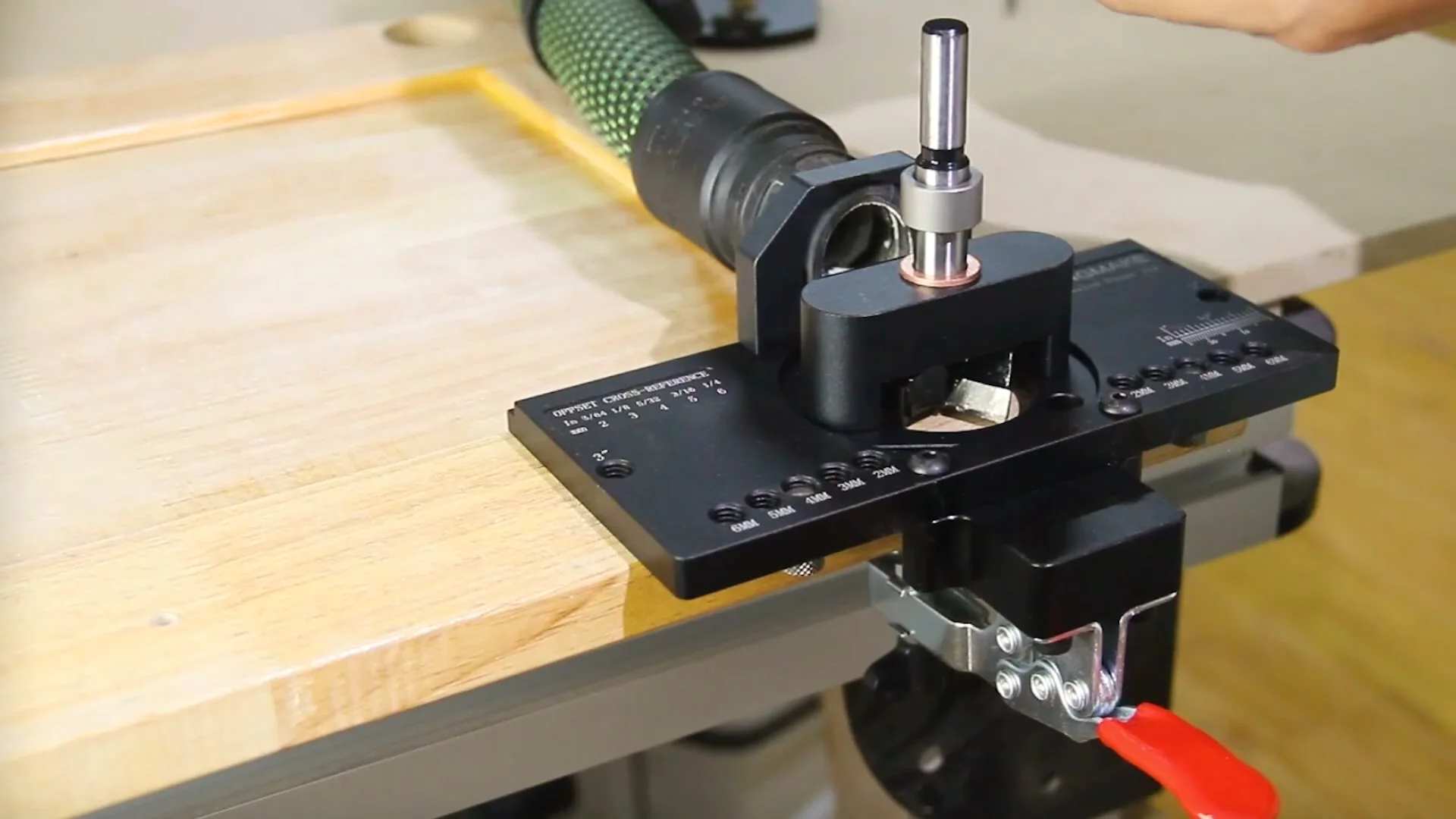
A grid of dog holes lets you clamp a part anywhere on the bench, square a cut against two dogs, or build a cutting table for a track saw. The first decision is the hole size, because it sets which accessories fit. The Bench Dog Hole Drill Guide comes in a 20 mm or a 3/4 in version, each with its own boring bit.
A 20 mm grid takes 20 mm bench dog fittings and accessories, and it turns the top into a Festool-compatible multifunction table. A 3/4 in grid takes 3/4 in dogs and clamps, such as our Bench Dog Clamp, which holds stock up to 1-3/4 in.
Spacing comes next. The guide sets holes at 64, 96, 128, 160, 192, 224 or 256 mm apart. Two extension rails place the first row from the bench edge without measuring, and four position pins drop into holes already drilled so the guide steps across the top in straight rows. Clamp the guide or the top for every hole, since a bench top is one part you cannot redo.
| Jig | Hole | Spacing | Set from |
|---|---|---|---|
| All Metal Pocket Hole Jig Kit | 3/8 in step bit | 3 guides at 3 spacings | Stock thickness, 1/2 to 1-3/4 in |
| Dowel Jig Kit | 1/4, 3/8 or 1/2 in bushings | 3 holes at a time, extension rod for rows | Edge stops in 1/8 in steps |
| Shelf Pin Jig, 1/4 in | 1/4 in, 7 hardened guides | 32 mm | Cabinet edge, 37, 50 or 64 mm |
| Shelf Pin Jig, 1/4 in and 5 mm | 1/4 in or 5 mm | 32 mm | Cabinet edge, 37, 50 or 64 mm |
| Bench Dog Hole Drill Guide | 20 mm or 3/4 in | 64, 96, 128, 160, 192, 224 or 256 mm | Bench edge, by extension rails |
Drilling safely with a hold-down
A short rail held by hand is the classic way a drill job goes wrong. In its pages on handheld drills, OSHA describes a bit that catches as it enters, so the loose stock spins with it, and a bit that is rarely guarded while it throws hot chips. Its answer is a hold-down fixture rather than the hands.
Its fix is a hold-down fixture rather than your hands, whenever possible. Every jig here carries one in some form. Think of the quick clamps of the pocket hole and dowel jigs, the anti-slip base of the dual shelf pin jig, the position pins that seat the dog-hole guide in finished holes. Use them on every hole, and keep your face out of line with the bit.
For holes away from the bench, our Drill Guide for Straight Holes holds a 3/8 or 1/2 in cordless drill square to the work in a 1/2 in self-locking chuck, with a depth stop. Its base has mounting holes for a clamp to the bench, rubber pads, and a V-groove that centers round stock.
Wood dust and the limits that apply
Drilling makes less dust than sanding, but a run of pocket holes or a bench full of dog holes still fills the air. The dust is more than a mess: the OSHA wood dust page lists skin and breathing problems, asthma among them, and names oak, walnut, birch, beech, mahogany, elm and ash among the hardwoods reported to cause nasal cancer in woodworkers at high exposures.
The NIOSH Pocket Guide lists wood dust as a potential occupational carcinogen, with nasal cancer as the cancer site. It names inhalation and skin and eye contact as the routes of exposure, and lists symptoms such as eye irritation, nosebleed, dermatitis, asthma, cough, wheezing, sinusitis and prolonged colds.
| Limit | Figure | Basis |
|---|---|---|
| OSHA limit, total dust | 15 mg/m3 | 8-hour time-weighted average |
| OSHA limit, respirable fraction | 5 mg/m3 | 8-hour time-weighted average |
| NIOSH recommended exposure limit | 1 mg/m3 | Time-weighted average |
The OSHA eTool names local exhaust ventilation at the source as the primary control. On our pocket hole jig that means the 1-3/8 in port and a shop vacuum running for every hole. The hinge jigs carry their own ports, and our guide to concealed cabinet hinges covers boring the 35 mm cups that go on the doors of the cabinet you just joined.
Each jig above is in the GOINGMAKE lineup, with its price and box contents on its own page.